Festival Uniques 2025
Festival Uniques 2025
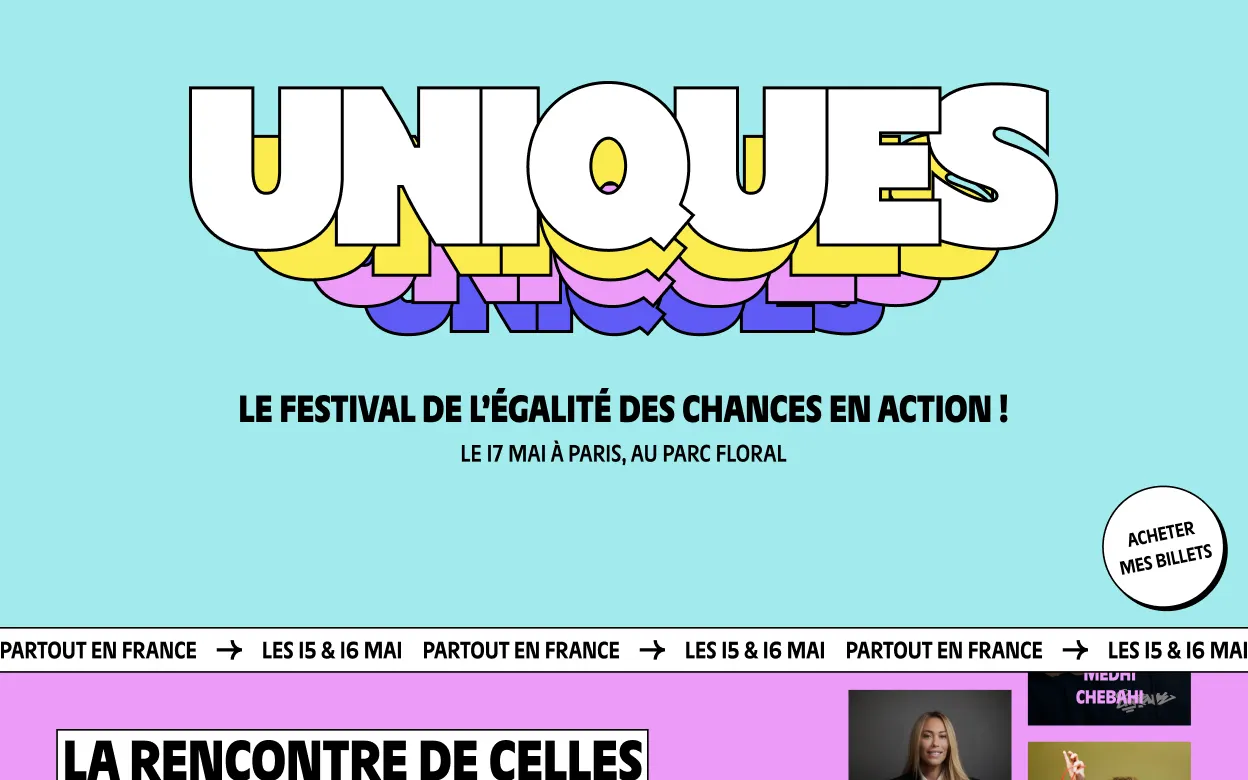
Festival UNIQUES, a nationwide cultural event series, needed a comprehensive digital platform to centralize their 2025 edition. With over 500 events scheduled across France, the challenge was to create a user-friendly website that could handle complex program data while providing seamless ticketing capabilities. The goal was to offer visitors an intuitive way to discover, filter, and book events while maintaining a premium aesthetic aligned with the festival artistic positioning.
My contribution
UI/UX design, Webflow development, CMS architecture for program and ticketing management
The team
2 designers
Year
2025
Festival UNIQUES, a nationwide cultural event series, needed a comprehensive digital platform to centralize their 2025 edition. With over 500 events scheduled across France, the challenge was to create a user-friendly website that could handle complex program data while providing seamless ticketing capabilities. The goal was to offer visitors an intuitive way to discover, filter, and book events while maintaining a premium aesthetic aligned with the festival artistic positioning.
Process
1. Discovery and Content Audit (Week 1-2)
- Requirements Gathering: Began with a deep dive into Festival UNIQUES existing materials and requirements.
- Data Structure Mapping: Mapped out the complex event data structure with 500+ events with varying dates, locations, categories, and ticket types.
- Workflow Collaboration: Collaborated with the festival team to understand their workflow for program updates and ticketing management.
- User Journey Definition: Identified key user journeys: event discovery, filtering, detailed viewing, and booking.
2. Design Phase (Week 3-5)
- Art Direction: Defined a premium, artistic visual language tailored to cultural event audiences. Established hierarchy principles to make dense event data scannable.
- UI Kit Development (Figma):
- Created a modular component library including data visualization templates for event listings, content blocks for event details and artist profiles, and responsive layouts optimized for all devices.
- Template Wireframes: Designed 5 core page templates with adaptive content slots for homepage with event grid, event detail pages, artist/performer profiles, ticketing flow, and contact information.
- Client Review: Presented wireframes in 2-week sprints for approval, incorporating revisions to meet Festival UNIQUES high standards.
3. Webflow Development (Week 6-7)
- CMS Architecture: Built 3 custom collections to power dynamic content: Events (fields: title, date, location, category, description, ticket link), Artists (fields: name, bio, photo, social links), and Venues (fields: name, address, capacity, accessibility info).
- Collection Relationships: Linked collections to enable cross-referencing (e.g., events tagged with categories, locations, artists). Implemented hide/show fields to simplify content entry for Festival UNIQUES non-technical team.
- Program Features: Developed filtering and search functionality to help users navigate the extensive program, implementing date-based navigation, location filters, category filters, and dynamic event detail pages that pulled content from the CMS.
- Ticketing Integration: Built a ticketing system within Webflow using native functionality, custom interactions, booking forms with validation, confirmation pages, and email notifications.
4. Testing and Launch (Week 8)
- Content Migration: Worked with Festival UNIQUES team to import all 500+ events into the CMS, ensuring data consistency, proper categorization, and complete information for each event.
- Team Training: Trained the team on how to update events and manage ticketing.
- QA Testing: Thoroughly tested the filtering system, the ticketing flow, and responsive design across devices. Verified that all event data displayed correctly and that the booking process worked seamlessly.
- Launch: Deployed the site in time for the festival announcement. The platform successfully handled the initial traffic surge and provided a smooth experience for early visitors.
Outcome
1. Business Impact
- Centralized Program Management: The new platform provided Festival UNIQUES with a single, manageable system for their 500+ events across France. The CMS allowed their team to easily update event details, add new events, and manage the program throughout the festival period.
- Improved User Experience: Visitors could now efficiently discover and book events thanks to the intuitive filtering and search system, clear information hierarchy, and engaging design that made it easy to navigate the extensive program.
- Successful Ticketing: The integrated ticketing system processed bookings smoothly, with users able to select events, choose ticket types, and complete purchases without friction. The system handled the scale of 500+ events without performance issues.
2. Technical Achievements
- Scalable Architecture: The CMS structure was built to accommodate the festivals growth, with the ability to easily add more events, add new categories, and add new features in future editions.
- Complex Data Handling: Successfully managed and displayed 500+ events with multiple attributes: date, location, category, and ticket type, all presented in a user-friendly interface.
- Rapid Development: Delivered a fully functional event platform with program management and ticketing in just 2 months, meeting the tight deadline for the festival launch.
3. Lessons Learned
- Large-Scale CMS Planning: Learned the importance of thorough planning when building CMS structures for large datasets. The event collection required careful consideration of relationships between data, filtering capabilities, and user experience for content managers.
- User Testing for Complex Systems: Discovered the value of early user testing for complex filtering systems. Some initial user confusion was resolved by simplifying the filter interface based on feedback.
- Collaboration Efficiency: Working as a team of two allowed for efficient division of labor: one focusing on design, one handling development, with regular syncs to ensure alignment.